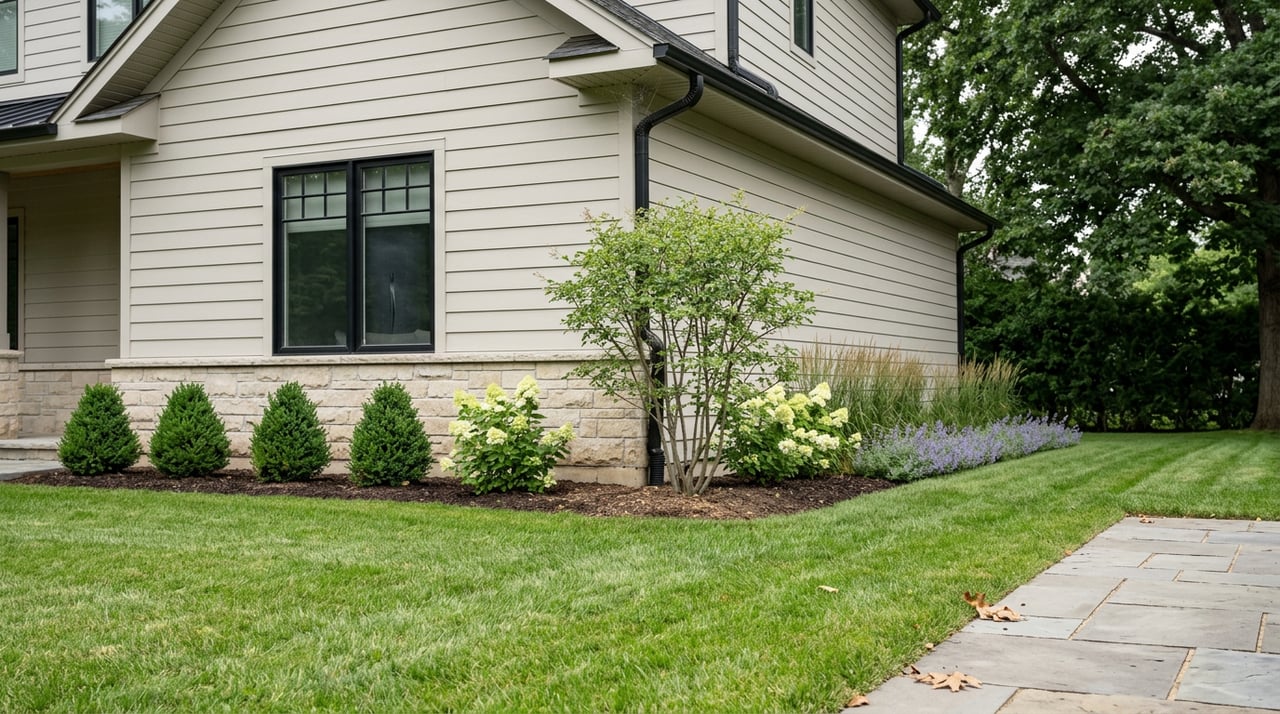
Pull the trailing twelve month numbers for Burr Ridge this summer and you'll find two housing markets sharing the same seven square miles. Detached single family homes closed at a median of $1,235,000 through May 2026, up 33.5% from a year earlier. Attached homes, the condos and townhomes, closed at a median of $500,000 over that same window, down 8.7% year over year, with closed sales off nearly 18% and average time on market stretching to 48 days.
Most explanations for that gap point to lot size, finishes, or school assignment. Those matter. But there's a mechanical reason baked into the split that rarely makes it into a listing description: the detached homes driving that appreciation are disproportionately the ones where wastewater treatment happens on the property instead of under the street. Buy into Burr Ridge's hottest price tier right now, and there's a real chance you're also buying into a well and septic diligence process that a condo buyer three miles away will never think about.
Two Markets, One Village
Burr Ridge sits across both DuPage and Cook counties, a fact the village has to manage on nearly every service line it runs, sewer included. The village likes to point out it was the first community in DuPage County to deliver Lake Michigan water to every customer. That milestone covers water. It says nothing about where wastewater goes once it leaves the house.
Some Burr Ridge neighborhoods are unambiguously on municipal sanitary sewer, maintained by the village itself. The Public Works Department names three specifically: Arrowhead Farms, Chasemoor, and Highland Fields, where the village runs proactive maintenance on sanitary lines and lift stations because topography won't let gravity do the whole job. Other addresses inside the village's borders are still unincorporated pockets, county islands surrounded by Burr Ridge but governed by DuPage or Cook County rules rather than the village's. A five bedroom home currently marketed in Ashbury Woods is described in its own listing as an "unincorporated residence," which is local shorthand for exactly this situation: private well, private septic, county oversight instead of village oversight.
Layer in the geology and the picture gets more specific. Local septic contractors flag Burr Ridge's porous limestone and high water table as conditions that push some properties toward mound systems, elevated drain fields built above grade with imported sand and gravel because a standard buried trench would flood. That's not a defect. It's an engineering response to soil the village sits on, and it shows up more often on the larger, older, unincorporated-adjacent lots than in a newer municipally served subdivision.
What Diligence Actually Costs
None of this is disqualifying. It is, however, a line item that a buyer moving from a condo or a newer subdivision often doesn't budget for until an inspector brings it up.
| Task | Typical Burr Ridge Cost | How Often |
|---|---|---|
| Routine tank pump-out | $300 to $600 | Every 3 to 5 years, every 2 to 3 years with heavy garbage disposal use |
| Drain field replacement | $10,000 to $30,000 or more | Once solids reach the field, a non-recurring but serious repair |
| Pre-occupancy well or septic inspection | Required, no fixed fee | Before a certificate of occupancy is issued on new or repaired systems |
The pump-out is routine maintenance, closer to an HVAC service call than a crisis. The drain field number is the one that changes an offer. Once solids get past a failed or missing baffle and into the field itself, you're no longer looking at pumping, you're looking at excavation and replacement, and DuPage County Health Department involvement on the permitting side.
The Permit That Outlives The Seller
Here's the part that catches people off guard at the closing table. DuPage County Health Department oversees every private sewage system in the county and keeps permit records tied to the parcel, not the owner. A documented history of violations or failed inspections on a property follows that address through a sale. The current seller isn't the only one whose paperwork matters. Whoever installed or last repaired the system left a record the county still has.
What DuPage County does not do is mandate a septic inspection for every ordinary resale. The requirement most buyers actually run into comes from the lender, not the county. Many loan programs, and increasingly many buyers who've read enough horror stories, ask for a current inspection as a condition of the contract even though the county itself stays silent on existing systems that aren't being installed or repaired. That distinction rarely gets explained clearly, and it leads to two different assumptions colliding mid-transaction: the seller who thinks no inspection is required, and the buyer's lender who requires one anyway.
In Burr Ridge, lot size and wastewater method tend to move together. The bigger the yard, the more likely the treatment is happening somewhere on that same property instead of under the street.
The Order Of Operations, If You're Serious
For a buyer or seller working through a Burr Ridge property that isn't clearly on municipal service, the sequence that avoids a last minute renegotiation looks like this:
- Confirm service type first, before anything else gets scheduled. Village Public Works can confirm whether an address sits inside the municipal sewer service area. If it doesn't, assume private septic and act accordingly.
- Pull permit history from DuPage County Health Department. A system with no permit on file, or one whose most recent permit predates a major addition or remodel, is a flag worth raising before an offer, not after an inspection contingency starts the clock.
- Order the tank inspection and pump-out together if the system hasn't been serviced in the last three to five years. A contractor already on site to pump can flag baffle condition and drain field health in the same visit.
- Test the well water if the property has one, separate from septic. Lenders frequently require both a functioning septic system and safe potable water before closing, and the two get tested by different processes.
- Budget the drain field number, not the pump-out number, into your contingency planning on any property with an older or undocumented system. You may never need it. Pricing the possibility in advance keeps a surprise finding from becoming a five figure renegotiation three weeks before closing.
Why This Matters More In August Than It Did Last Spring
MLS inventory in the first week of August 2026 showed 56 single family homes active in Burr Ridge against just 5 townhomes and 8 condos, with the Carriage Way subdivision carrying more active listings than any other single pocket of the village. That imbalance, more detached inventory moving at a much higher price point while attached inventory sits and softens, means more buyers than usual are competing for exactly the housing stock most likely to carry a private well and septic system rather than a municipal hookup.
A hot, appreciating market compresses timelines. Buyers write offers faster and with shorter contingency periods when they're worried about losing a home to another bidder. That's precisely the environment where a well and septic issue gets discovered too late to negotiate calmly, because nobody built in the extra week a permit records request or a drain field probe actually takes. Doing that homework before you write the offer, not during the inspection period, is the difference between a smooth close and a renegotiation under pressure.
FAQ
Does DuPage County require a septic inspection before I can sell a home in Burr Ridge? Not as a blanket rule for existing systems. The county requires inspection and permitting for new installations and repairs, plus pre-occupancy approval before anyone moves into a home with a new or altered system. At an ordinary resale, the push for an inspection usually comes from the buyer's lender rather than a county mandate.
How do I find out whether a specific Burr Ridge address is on municipal sewer or private septic? Start with the Village of Burr Ridge Public Works Department, which can confirm whether an address sits within a municipal sanitary sewer service area, including the three neighborhoods where the village actively maintains lift stations: Arrowhead Farms, Chasemoor, and Highland Fields. If it's outside that service area, DuPage County Health Department's permit records are the next stop.
What is a mound system, and why do some Burr Ridge properties have one? A mound system raises the drain field above natural grade with imported sand and gravel instead of burying it in a standard trench. Local contractors point to it as a common workaround on lots where the water table sits too high for a conventional field to drain properly, a condition tied to the clay and limestone soils under parts of the village.
Whether you're weighing an estate lot in Highland Fields or trying to figure out what's actually under the yard on a property that caught your eye in Ashbury Woods, this is exactly the kind of due diligence that's easy to underestimate from a listing photo. Tatiana Hernandez has spent years on both sides of Chicagoland transactions, including the investor and renovation work that makes private infrastructure questions second nature rather than an afterthought. Let's Connect before you write the offer, not after the inspection period starts the clock.