"In Downers Grove specifically, even tear-down redevelopment on stand-alone lots has been limited since the early 2000s," Rick Champine, area president of M/I Homes, told Chicago Agent Magazine last November. He was announcing pre-sales for Talon Preserve, the builder's subdivision on the old radio-tower site at 39th Street and Cumnor Road. He was making a sales point about how rare new homes are here. For a buyer, the same fact sets up a different math problem.
If buying new in Downers Grove is rare and expensive, many buyers will get a newer house the other way. They'll buy an older home on a mature lot and then add on, rebuild, or pour a bigger patio and driveway. That plan runs through the Village permit counter. One set of rules there already affects the trees on your lot, and the Village Council has been talking about a second set aimed directly at them.
The rule that already applies to your addition
Since January 1, 2019, every new single-family home and every "Major Residential Addition" in Downers Grove has had to include stormwater storage on site. The amount depends on how much new hard surface the project adds. Here is the Village's summary table:
| Net new impervious area | Storage volume required | Sump pump storage required |
|---|---|---|
| No change or reduction | 0 cubic feet | 50 cubic feet |
| 1 to 699 sq ft | 100 cubic feet | 50 cubic feet |
| 700 to 999 sq ft | 150 cubic feet plus required PCBMP storage | 50 cubic feet |
| 1,000 to 1,999 sq ft | 200 cubic feet plus required PCBMP storage | 50 cubic feet |
| 2,000 sq ft or more | 250 cubic feet plus required PCBMP storage | 50 cubic feet |
PCBMP stands for post-construction best management practices. Once a project crosses 700 square feet, the storage has to be built as a defined feature on the site plan, and a construction fence has to go up around it before any other work or demolition starts. The same summary says sump pump and downspout discharge should be piped toward the street wherever the slope of the lot allows.
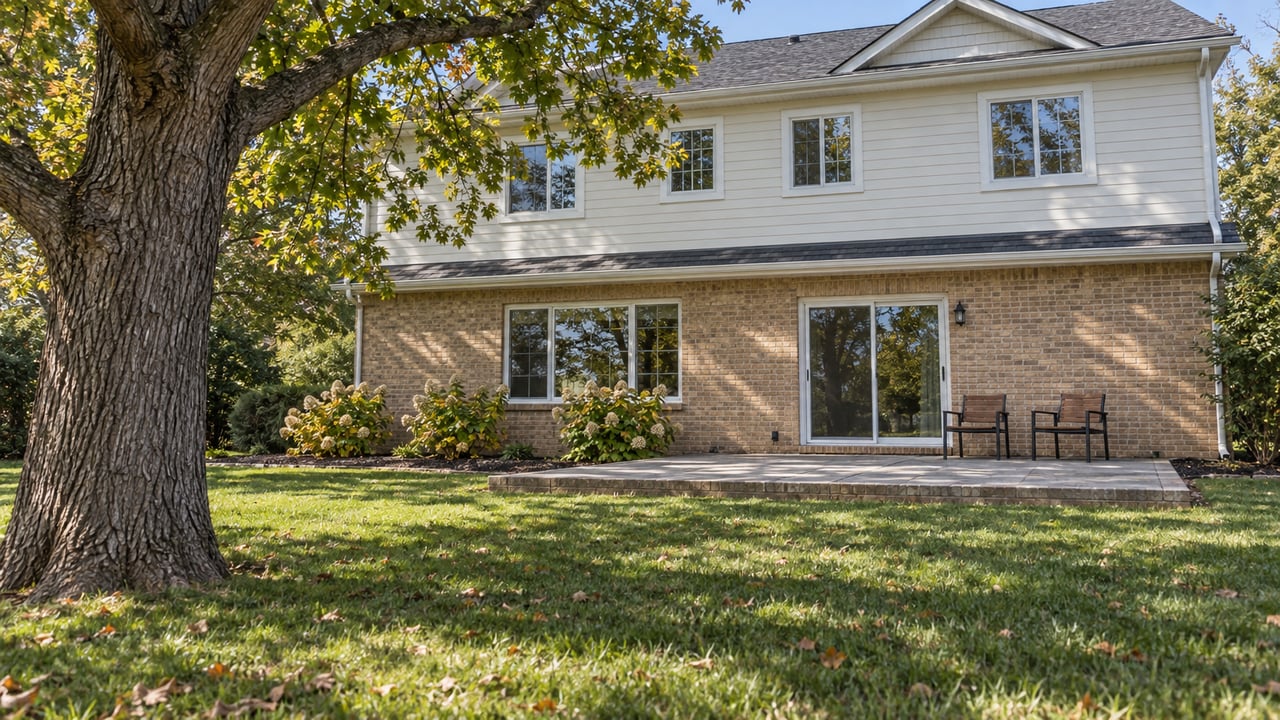
For a buyer with an older home and big trees, this matters because the storage has to fit somewhere on the lot. On a lot with a mature canopy, that space is usually under or near the trees. Commissioner Mike Davenport said so on the record at the August 11, 2026 Village Council meeting. He argued that the Village's current requirements for underground detention and water retention "are actually at odds with the goal of preserving trees," and he later added that pooled stormwater can damage tree roots.
A year earlier, on September 2, 2025, Davenport had asked to revisit the stormwater threshold. At that Village Council meeting, he suggested basing it on lot size rather than project size and described the current rule as applying to projects over 400 square feet. The Village's own published table starts at one square foot of new impervious area. That gap is a good reason to get the current threshold for your specific project from the Village in writing before you count on a number.
The rule being discussed for the trees themselves
At the same August meeting, Village Manager Dave Fieldman confirmed that Downers Grove's ordinances are "currently silent on private trees." The town's canopy grew with no private-tree rules at all. Davenport made the same point, noting that Downers Grove has "an incredible tree canopy" despite having no regulations.
Several things put the topic on the agenda. A private-tree ordinance had appeared on an earlier Council priority list and was dropped for lack of staff capacity. At the September 2025 meeting, residents spoke in favor of bringing it back. One said the oak trees in her yard were what drew her to buy her home. At the 2026 discussion, Commissioner Leslie Sadowski-Fugitt mentioned the recent loss of an oak grove in the Village.
Jason Michnick, the Village's Environmental Sustainability Coordinator, presented staff's research. He said Glen Ellyn's ordinance came closest to what the Council had asked for. He also told the Council that the Morton Arboretum and the Chicago Regional Tree Initiative publish a model ordinance that covers all tree removals, not just those tied to construction. Commissioners raised these ideas:
- A permit trigger. At the August 11, 2026 Village Council meeting, the Glen Ellyn approach was described as applying only when someone requests a permit. It would not cover a homeowner removing a tree with no project underway. Davenport wanted the trigger to include driveway, patio and paving permits, not just building permits.
- Boundary trees. Sadowski-Fugitt said she "strongly supports" protecting trees along property lines, and Mayor Bob Barnett said boundary trees were his main interest.
- A look-back. Commissioner Chris Gilmartin backed fines when someone removes a tree and then applies for a permit. Davenport wanted to settle how many years back the rule would reach.
- Fee-in-lieu and replacement. Commissioner Rob Roe favored planting one tree for each tree removed, with fee-in-lieu money going to parkway trees.
- Trade-offs for builders. Davenport suggested easing stormwater requirements and offering lot-coverage bonuses as incentives to keep trees.
The Council did not agree on one approach. Barnett said he did not want to add construction costs through new fees and still needed to be convinced. Commissioner Martin Tully warned against overregulating. Fieldman said the Village tree team would review the feedback and report back, with "no specific timeline yet." According to the Village Council minutes and agendas reviewed for this post, nothing was proposed or adopted at the August 18, September 1, September 8 or September 15 meetings. The posted October 6 agenda has no tree item either.
Why Glen Ellyn is the rulebook to read
Glen Ellyn is where Tatiana is based, and it's the model Downers Grove staff pointed to. Its process shows what could apply to a Downers Grove permit one day. Under Glen Ellyn's Tree Preservation Guidelines, an approved Tree Preservation Plan is required before the Village issues a building permit for work that disturbs more than 300 square feet. The applicant submits a tree survey, an action plan and approved fencing, and has to notify adjacent property owners. The survey has to cover trees on the lot, trees on neighboring lots within 15 feet of the property line, and trees in the public right-of-way. It also records protected trees removed in the previous year.
On site, the fencing is 48 inches high and set on posts no more than 10 feet apart. It stays up until final grading and landscaping are finished and the village forester signs off. Glen Ellyn defines a tree's critical root zone as one foot for every inch of trunk diameter, with a six-foot minimum. Run that formula on a 30-inch oak and you get a 30-foot radius where construction activity is restricted. On a typical older lot, that can decide where an addition or a stormwater feature is allowed to go.
Two cautions apply. The research for this post did not confirm Glen Ellyn's exact diameter thresholds for protected trees or its replacement fees. Glen Ellyn's own board was also discussing possible amendments to these rules in May 2026. Downers Grove would write its own version, and as of today it hasn't.
The numbers behind the plan
New single-family construction in Downers Grove stays small. Census building permit data shows 61 new residential units permitted in 2024, all single-family, with $41.0 million in reported construction value. The AEI Housing Center estimated about 58 new single-family homes a year from 2014 to 2024, with a median infill value of about $1.05 million in 2023 dollars.
M/I Homes lists Talon Preserve homes from $1,269,990, observed October 4, 2026. Those are asking prices, not closed sales. For comparison, Illinois REALTORS data puts the August 2026 median for detached single-family homes across all of DuPage County at $553,500 on 624 closings. That is a countywide figure, not a Downers Grove number, but the gap is wide. A new home in Talon Preserve starts at more than twice the county's typical detached sale.
The broader county market gives buyers somewhat more room than a year ago. In August 2026, DuPage inventory reached 1,415 homes, up 6.6% from August 2025. Homes took an average of 19 days to sell, up from 17. A slightly slower market means more time for due diligence. That extra time is best spent checking whether your plans for the lot will actually work.
What to check before you write an offer
- Sketch the footprint first. Add up the new house area, driveway and patio to estimate net new impervious area, then find your row in the stormwater table.
- Find where the storage could go. Your contractor or civil engineer can identify a spot for it that stays clear of the root zones of the trees you want to keep.
- Walk the property lines. Note trees near or on the boundary. Boundary trees came up the most at the Council discussion, and under the Glen Ellyn model the survey extends 15 feet onto the neighbor's lot.
- Confirm the current threshold with the Village. Davenport's 400-square-foot description and the published table don't match, so get the answer for your exact project.
- Check the Council agenda before closing. A look-back provision was discussed, so removing trees before your permit application is the kind of timing a future rule could reach.
Mayor Barnett said the Village issues more than 400 permits a year and that, in his view, only a small number of them cause problems for trees. Plan your project so it isn't one of them.
FAQ
Does Downers Grove regulate removing trees on private property today? As of the August 11, 2026 meeting, the Village said its ordinances are silent on private trees. The Village's parkway-tree rules cover significant trees in the public parkway. No private-tree ordinance has been adopted since that meeting.
Would a new tree rule affect a homeowner who isn't building anything? Under the Glen Ellyn approach, as described to the Council, the rule would be triggered only by a permit request. Downers Grove has not settled on that or any other approach.
Does the stormwater storage rule apply to every project? The Village summary applies it to new single-family homes and major residential additions. Ask the Village how your specific project is classified before you budget for it. This post is general information, not legal advice.
If you're looking at a Downers Grove home with an oak you love and an addition in mind, I'll help you check the stormwater math, the boundary trees and the latest from the Village Council before you commit, in English or Spanish. Let's Connect with Tatiana Hernandez.